

Background
In 2024, under the leadership of Multnomah County Sheriff Nicole Morrisey O’Donnell, the Sheriff’s Office launched the Corrections Recommendations Project to make meaningful changes to ensure the safety and wellbeing of adults in custody and staff working at the Multnomah County Detention Center and Inverness Jail.
Both of these facilities undergo regular evaluations required by state and county legislation. In addition, following deaths in custody in 2023, the Sheriff directed a thorough examination of security operations, health services and the death investigations by the National Institute of Corrections (NIC) and Oregon State Police (OSP). Leaders from across the Sheriff’s Office and its partners worked together to develop and implement actionable goals to make improvements to the jail facilities, operations and staffing informed by these evaluations.
Purpose
The purpose of the Corrections Recommendations Project was for the Sheriff’s Office, with its partners, to develop and implement a meaningful response to reports received in 2023 and 2024. In all, over 407 recommendations were synthesized into 56 actionable goals. Six workgroups were created to develop plans for implementing a number of goals. Workgroups included:
- Corrections Operations Workgroup: (19 Goals) MCSO Members from Corrections Division
- Data Workgroup: (3 Goals), MCSO Members from Corrections Division, Executive Team and Business Services Division
- Facilities Workgroup: (5 Goals) MCSO Members from Corrections Division, Business Services Division, Multnomah County Facilities and Property Management
- Interagency Recommendations Workgroup: (14 Goals) MCSO Members from Corrections Division, Multnomah County Corrections Health
- Oregon State Police (OSP) Recommendations Workgroup: (7 Goals) MCSO Members from Corrections Division, Law Enforcement Division, Business Services Division
- Staffing Workgroup: (8 Goals) MCSO Members from Corrections Division, MCSO Human Resources, Business Services Division
Representatives were selected based on their subject matter expertise, their proximity to the work and their ability to represent those most impacted by proposed changes.
Workgroup members were then asked to consider the strategies to implement goals that would most effectively result in lasting change.
Methodology
In August of 2025, a project team launched an evaluation to engage leaders from the Sheriff’s Office and key partners to determine whether or not we achieved the purpose of the project and the lessons we learned as we respond to observations and recommendations in the future.
The evaluation plan included a brief survey, focus groups and a live poll administered during focus groups.
• Invitation to participate in a focus group were sent to 19 individuals.
• Invitations to complete the survey were sent to 59 individuals.
We had 13 survey respondents and 23 focus group participants for three focus groups. The focus groups included four questions for respondents to answer using a live poll. Nineteen of the respondents across the 3 focus groups participated in the live poll. The survey questions and focus group prompts are included in Appendix II.
Findings - Themes and Recommendations
Four primary themes emerged: Transparency, Accountability, Interagency Collaboration, and Agencywide (MCSO) Leadership Collaboration.


Overall, the majority of respondents felt the project accomplished its purpose, the right people were involved in the project, and that transparency and accountability were prioritized. Representatives from five out of the six
workgroups either answered the survey or participated in a focus group that included polls. No respondents strongly disagreed with any of the statements.
Survey and Focus Group Polls
Overall, the majority of respondents felt the project accomplished its purpose, the right people were involved in the project, and that transparency and accountability were prioritized. Representatives from five out of the six workgroups either answered the survey or participated in a focus group that included polls. No respondents strongly disagreed with any of the statements.
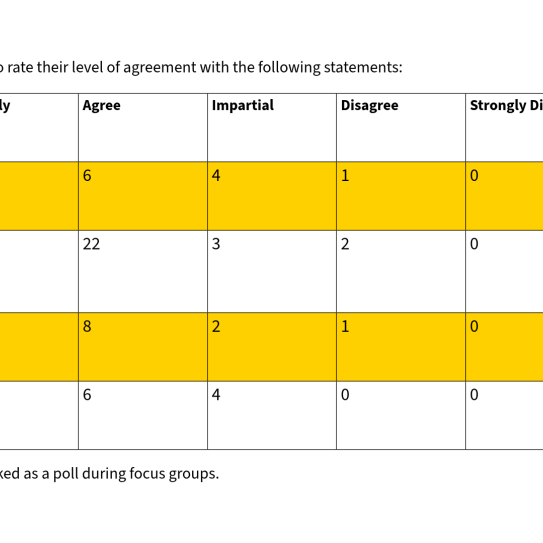
Respondents were asked specifically about the tools used by the workgroup participants and the project webpage and dashboard. All of these questions were asked both in the survey and using a poll during focus groups. No respondents strongly disagreed with any of the statements.
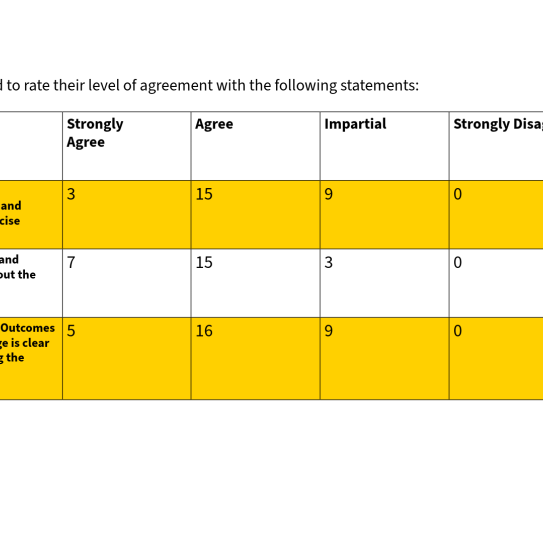
Very few respondents disagreed with any of the statements included in the survey or polls. Only three respondents disagreed that we accomplished the purpose of the project and only one respondent disagreed that the project prioritized transparency. For a deeper analysis, the evaluation team distinguished respondents who participated in workgroups from members of MCSO leadership. On average, members of MCSO leadership were about 10% more likely to agree or strongly agree with all statements.
When asked about the materials for workgroups, the project webpage and the project dashboard (located on the project webpage), respondents were asked to choose “Not Applicable” or “I’m not sure” if they had not seen or interacted with those tools.
• Workgroup members were more likely to Agree or Strongly agree that materials for individual workgroups were clear and concise (63%) compared to MCSO Leadership (46%).
• Conversely, workgroup members were more likely to choose “Not Applicable” or
“Impartial” when asked if they felt the project webpage or dashboard was clear and
helpful.
When asked about the project webpage, 28% of workgroup members versus 8%
of MCSO Leadership felt it was clear and helpful.
When asked about the project dashboard, 42% of workgroup members felt it
was clear and helpful compared to 23% of MCSO Leaders.
These results appear to indicate that workgroup members were less likely to have reviewed the project webpage and/or dashboard than MCSO Leadership.
Conclusion
Overall, the evaluation found the 2024 Corrections Recommendations Project accomplished its purpose, included the right people, prioritized transparency and accountability and fostered collaboration with Corrections Health and agencywide at the Sheriff’s Office.
There are opportunities to improve how the Sheriff’s Office meaningfully responds to recommendations from required and requested evaluations to ensure we are providing opportunities for frontline staff and external partners to have more input and awareness.
Appendices
Appendix I: Evaluation Feedback
The final draft of this evaluation was provided to participants on November 26, 2025 and given until December 8, 2025 to provide feedback. Participants were given the option to either provide feedback anonymously via survey, through email or by conversation with any of the project members. No participants responded.
Appendix II: Survey and Focus Group Questions
Survey and Focus Group Questions:
1. The Purpose Statement for this project states: “The Multnomah County Sheriff’s Office, with its partners, will develop and implement a meaningful response to the reports received in 2023/24, to prioritize the safety, security, and wellbeing of adults in our custody and staff working in our facilities while centering the values and principles of the Sheriff’s Office.” Do you feel that the project accomplished it’s purpose?
2. Do you believe the right people were included in this project to achieve our purpose?
3. For the purpose of this evaluation, transparency is defined as being open to feedback, communicating clearly and honestly and defaulting to sharing information. Do you feel this project prioritized transparency?
4. The materials for individual workgroups to develop goals and strategies were clear and concise.
5. The project webpage is clear and helpful in communicating about the project.
6. The project dashboard in the Outcomes section of the project webpage is clear and helpful in communicating the progress of the project.
7. For the purposes of this evaluation, accountability is defined as a focus on establishing clear expectations, fostering open communication, providing regular feedback and identifying measure of success. Do you feel this project prioritized accountability?
8. What do you feel most proud to share about this project and/or your involvement?
9. Any other thoughts and/or comments to share about the Corrections Recommendations Project 2024?
Download the Report Here
Evaluation Team:
Andrew Campbell, Workplace Equity & Training Specialist
James Eriksen, Staff Assistant
Jenny Carver, Deputy Chief of Staff
Date: March 20, 2026